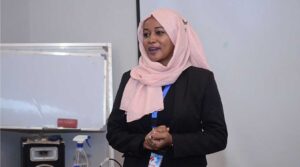



Amidst the political turbulence and armed conflicts ravaging Sudan, Sudanese women are finding a new avenue to assert their agency and drive positive change – the climate action movement.
In a country grappling with the devastating impacts of desertification, droughts, and erratic rainfall, Sudanese women are emerging as frontline defenders of the environment and champions of sustainable development. Traditionally relegated to the domestic sphere, these women are now leveraging their unique perspectives and lived experiences to spearhead community-led initiatives that address the intersection of climate change, gender, and social justice.
From establishing women-led tree planting projects to advocating for renewable energy solutions, Sudanese women are bringing a holistic, intersectional approach to tackling the climate crisis. Their efforts not only mitigate environmental degradation but also empower marginalized communities, foster livelihood opportunities, and challenge patriarchal structures that have long constrained their participation in decision-making.
“Climate change doesn’t discriminate, but its impacts are far more severe for women and marginalized groups,” says Aisha, a young environmental activist from Darfur. “By taking on leadership roles in the climate movement, we’re not just protecting our planet, but also reclaiming our rightful place as agents of change in Sudanese society.”
The journey, however, has not been without its challenges. Sudanese women climate activists face multifaceted barriers, ranging from limited access to resources and technology to deep-rooted cultural biases and security risks. Yet, their resilience and determination have inspired a new generation of Sudanese women to join the fight for a sustainable and equitable future.
As the country navigates the complex web of political and economic instability, the rise of Sudanese women as climate champions offers a glimmer of hope. Their efforts not only address the environmental crisis but also pave the way for a more inclusive, just, and prosperous Sudan – one where women’s voices are amplified and their contributions are recognized as essential to the nation’s resilience and development.
Nisrin El-Saim spoke to UN News about her call to increase investment in renewable energy as a strategy for sustainability and peace, at a time when competition over natural resources is increasing. She also highlighted the pivotal role of youth in adapting to and preparing for climate change.
El-Saim addressed the major challenges she faced in her journey of environmental advocacy. She said these challenges were not related to being a woman and a young person, but were more associated with access to resources and the political system in Sudan.
She said, “We faced many challenges, including restrictions on freedom of movement and peaceful assembly, as well as various human rights violations. There were also challenges related to travel and mobility.”
Nisrin El-Saim is the former Chair of the UN Secretary-General’s Youth Advisory Group on Climate Change.
When asked about the importance of discussing climate change at a time when the world is preoccupied with conflicts and wars, she replied, “Nature is stronger than any weapon. We have long misused and mistreated nature, despite the fact that it has given us so much. When nature decides to take revenge, no weapon or human force will be able to stand in its way. And all the conflicts and wars we are experiencing now will seem like a mosquito bite compared to the disasters and calamities that climate change can bring, which will not stop because of wars.”
In her view, people need to learn a valuable lesson from the COVID-19 pandemic, which they have not benefited from yet. This pandemic, as El-Saim says, did not respect any borders or laws and led to heavy losses. She warned that people will lose even more if they do not deal with nature better.
The Sudanese activist stressed that the struggle in the field of climate action ensures the future of future generations and helps the least developed countries, which are the most affected by climate change.
She said that climate action also helps create job opportunities for young people who have lost their jobs due to natural disasters. And most importantly, this struggle preserves the existence of humanity “because if the situation continues as it is, we will not be able to live on planet Earth and we have no alternative planet.”
Regarding the most urgent steps to mitigate climate change, Nusreen says that the first step is to significantly reduce emissions. She adds that attempts to adapt and mitigate the effects of climate change have a limit, “and when we reach the point of collapse, there is no room for further adaptation, and any attempt to find funding for losses and damages is nothing more than a temporary solution,” in her opinion.
Moving on to the fundamental challenges facing Africa and Sudan in particular in combating climate change, she states that in the context of conflicts and wars, it is impossible to develop any development program in the absence of security and peace.
In the words of Nusreen, the fundamental challenge in Sudan’s fight against climate change is the lack of security and peace. As she rightly points out, without stability and an end to armed conflicts, it is impossible to develop the comprehensive, long-term programs needed to tackle this crisis.
Nusreen’s stark warning about the limitations of adaptation efforts is also a critical point. Once climate impacts reach a point of systemic collapse, there will be no room left for further adaptation. Any attempts to merely find funding for losses and damages will be nothing more than temporary band-aids.
The imperative, therefore, is to act quickly and decisively on the first line of defense – reducing greenhouse gas emissions rapidly and at scale. This requires political will, significant resources, and coordination well beyond Sudan’s borders. The international community must step up with the necessary climate finance and technology transfers to support Sudan’s transition to a low-carbon, climate-resilient future.
At the same time, Sudan must prioritize restoring peace, security, and good governance as an essential foundation for implementing ambitious climate action plans. Without these basic conditions, any climate resilience efforts will remain fragile and unsustainable. The time for half-measures has passed. Sudan, together with the global community, must rise to the defining challenge of our era. The decisions made today will echo for generations to come, determining whether Sudan can safeguard its people, its economy, and its natural heritage in the face of accelerating climate impacts. Nusreen’s warnings must be heeded, and her call to action must be answered with utmost urgency.