
Amidst the political and economic turmoil that has gripped Sudan in recent years, a quiet revolution is taking place led by the country’s resilient women. While their male counterparts have been embroiled in power struggles, Sudanese women have been rolling up their sleeves and getting to work, using their ingenuity and determination to support their families and communities.
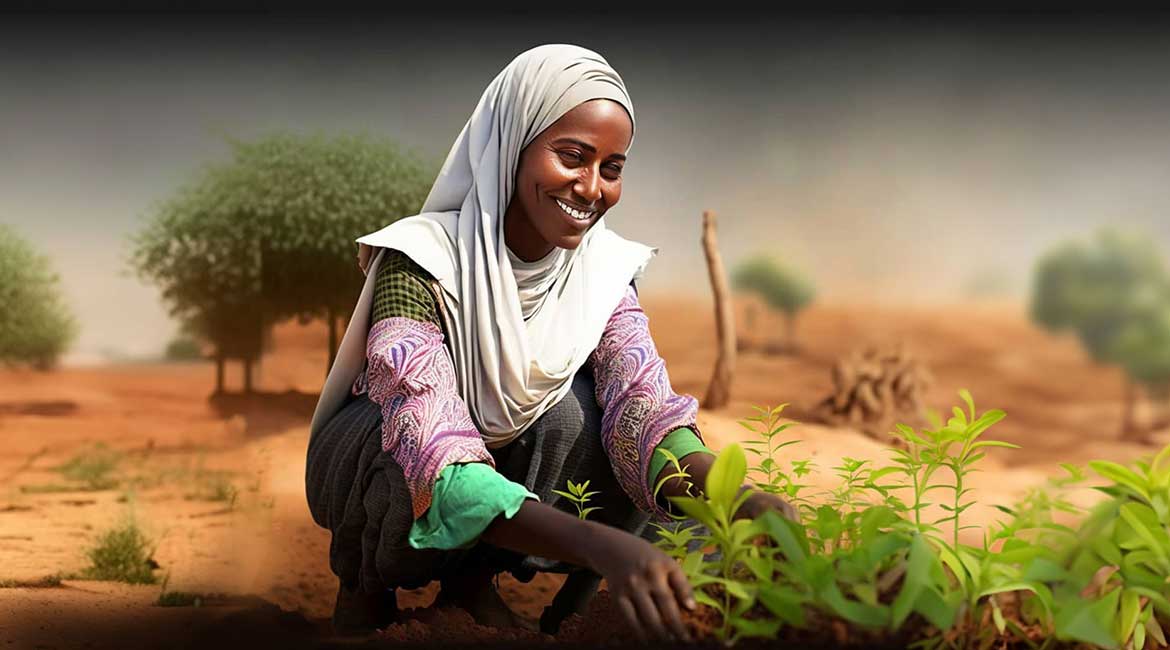
In the rural areas, women have become the backbone of Sudan’s agricultural sector. With men often absent due to conflict or economic migration, women have taken over the farming responsibilities, tending to crops and livestock with skill and passion. Fatima, a 42-year-old mother of five, proudly shows off her thriving vegetable garden, explaining how she has doubled her family’s food production through innovative farming techniques she learned from other women in her village. “We may not have much, but we will not let our children go hungry,” she says with resolve.
The urban centers tell a similar story. In Khartoum and other cities, Sudanese women are establishing small-scale manufacturing enterprises, producing everything from textiles and pottery to soap and food products. Amna, a 38-year-old widow, started a small workshop making traditional Sudanese handicrafts. “I had to find a way to support my family after my husband passed away,” she explains. “With the training and microloan I received, I’m now able to earn a steady income and provide for my children.”
These women are not only lifting their own families out of poverty, but are also contributing to the broader economic development of their country. Their products are in high demand, both domestically and internationally, as consumers seek authentic, ethically-sourced goods. And through their hard work and entrepreneurial spirit, they are shattering gender stereotypes and paving the way for a more equitable future.
The challenges these Sudanese women face are immense – from political instability and limited access to resources to cultural biases and domestic responsibilities. But their resilience and determination are even greater. As one woman put it, “We are the hope and light for our nation. Nothing will stop us from building a better tomorrow.”
Zarqa Mohakar spends her days toiling in her farmland and tending to her children, despite suffering from a disease caused by the humidity that has plagued her for over a decade.
Zarqa is one of hundreds, if not thousands, of Sudanese women who work in agriculture and farming, as well as some similar professions, amidst the harshest of economic conditions.
Nevertheless, Zarqa plans – as she says – to educate her children with the help of her husband by farming the land, away from the noise and bustle of the city, which she has always felt does not suit her.
Similarly, others like Mu’adila Abusail exert great efforts in their fields for the same purpose: raising their children and achieving academic success that may lift the entire family from the state of destitution they live in, to a sought-after prosperity for all.
Neither Zarqa nor Mu’adila see any hope in seeking employment outside of agriculture, which is no longer profitable due to the weak prices of all cash crops and even essential agricultural products.
The only refuge
In contrast, Mu’adila – who works with her daughters in harvesting peanuts – says that the prices of the crops they produce, and those of their peers, do not match the fatigue and hardship they endure.
While Zarqa Mohakar – who sees no alternative to agriculture – affirms that farming is the only refuge that meets the needs of the poor like her. She added that all women in the villages are without education, health, or any of the elements of a decent life.
Unofficial reports from local volunteer organizations and social activists indicate that the number of women working in agriculture and animal husbandry has reached more than 70%.
Statistics from the Arab Labor Organization, about four years ago, indicate that the contribution rate of Sudanese women in agriculture is 82%, and pastoral women represent 20% of the female community.
Guarantee constraints
The Director of Public Resources for Women in the National Project for Rural Women’s Development, Mawahib Muhammad Ahmad, announced that the Central Bank of Sudan has allocated 70% of resources for rural financing, and 12% to encourage rural women to borrow and save, activate the Women’s Portfolio, facilitate access to credit and loans, and ease the constraints of guarantees on them.
Women play a significant role in the agricultural sector of Sudan. The majority of Sudanese households rely heavily on women’s contributions to agriculture for their food security and income. While the Gedaref region does not differ significantly from the rest of Sudan’s states, the region provides a large portion of the country’s staple crops such as millet, sorghum, peanuts, and vegetables, largely driven by the contributions of women farmers.
The agricultural economy in the region is heavily dependent on the contributions of these women farmers, whose roles continue to be vastly undervalued. Although the rural women farmers play an active part in supporting the agricultural economy of the area, they have routinely been neglected by policymakers and excluded from accessing the services and resources they need to effectively manage their land.
Sudanese Entrepreneur:
War Will Not Break Our Determination, and the Sudanese Woman is Capable of Rising Again
Ala’a Hamdtou, the CEO and founder of Solar Food, a clean technology startup in Sudan, believes that despite the challenges posed by the ongoing war, Sudanese women have the ability to rise above adversity and contribute significantly to the nation’s development.
Hamdtou, a mother of three daughters, has established Solar Food, a pioneering company in the dried food industry in Sudan. The company produces a diverse range of organic dried food products using solar drying technology, catering to both the retail and wholesale markets.
“The core idea behind my factory is to reduce agricultural waste in Sudan, as 40% of agricultural products are wasted,” Hamdtou explains. Her vision is to have a positive impact on people’s lives by assisting small-scale farmers and promoting the benefits of solar drying.
Hamdtou believes that the Sudanese woman is resilient and capable of overcoming the challenges posed by the war. “The war will not break our determination,” she says. “The Sudanese woman has the ability to rise again and contribute to the development of our country.”
Despite the ongoing conflicts and economic difficulties, Hamdtou remains optimistic about the future. She is committed to empowering other women entrepreneurs and providing them with the resources and support they need to succeed.
Hamdtou’s story is a testament to the strength and determination of Sudanese women, who continue to play a vital role in the country’s economic and social progress, even in the face of adversity.
The War Wreaks Havoc on the Dreams of Sudanese Women
Like thousands of other Sudanese men and women, Ala’a Hamdtou has been affected by the ongoing war in her country. Her factory, which she founded in 2017 in the industrial area of Khartoum Bahri, was completely destroyed.
Ala’a says, “We were able to develop our products from one product to more than 22 products, and we made a name for ourselves in many countries. We were exporting our products to seven countries, including the United Kingdom, Saudi Arabia, the United Arab Emirates, and Qatar. But unfortunately, the war came, and overnight, the factory was completely destroyed, and we had no choice but to flee and save our lives.”
Ala’a’s story is a testament to the devastating impact of the war on the dreams and aspirations of Sudanese women. Despite her hard work and success in building a thriving clean technology startup, the war has forced her to abandon her business and flee for her safety.
The destruction of Ala’a’s factory is a tragic loss not only for her but for the entire Sudanese economy and the country’s efforts to promote entrepreneurship and innovation. The war has shattered the hopes and dreams of countless Sudanese women like Ala’a, who were striving to make a positive impact on their communities and contribute to the nation’s development.
As the conflict rages on, the Sudanese people, especially women, face an uphill battle to rebuild their lives and reclaim their dreams. The resilience and determination of Sudanese women like Ala’a, however, remain a beacon of hope for a better future.
Throughout their lives, young entrepreneurs and entrepreneurial women in Sudan have faced a host of difficulties,
as Alaa Hamdtou explains. She says, “What has happened to us now is extremely painful and regrettable, but we have no choice and we cannot afford the luxury of being complacent, lamenting our luck, or even just thinking about what has happened. We have also learned that no one will help us and that we need to help ourselves, and how we can rise up again. There are many qualified women from excellent professional backgrounds, such as engineers and doctors, who have lost everything and are humble enough to start from scratch and take up small professions in order to survive.”
In conclusion, Alaa Hamdtou addressed a message to the Sudanese woman,
saying: “I tell the Sudanese woman that you are capable and have proven that you are capable. I tell you that the displacement and violence that have happened to you are not the essence of the situation in Sudan. Sudanese women throughout history have been leaders, warriors, and queens, and the first parliamentarian in the Middle East was a Sudanese woman. This is our origin, not the repression that occurred to us during the previous regime and the situation that is happening to us now. And I am sure that we will be able to rise up again.”
Sudanese Women in Industry and Production:
Sudanese women have played a central role in economic production and industrialization throughout the country’s history. Despite the many challenges and obstacles they have faced, Sudanese women have consistently demonstrated their resilience, innovation and entrepreneurial spirit.
In the agricultural sector, women have long been the backbone of food production, managing farms and overseeing the cultivation of vital crops. Their hands-on knowledge of farming techniques and crop varieties has been essential to ensuring food security for Sudanese families and communities.
In the handicraft industry, Sudanese women have excelled at producing intricate textiles, pottery, baskets and other traditional wares. These products not only preserve cultural heritage, but also provide important income streams for women and their households.
Many Sudanese women have also ventured into manufacturing, establishing small and medium-sized enterprises that produce everything from soap to furniture. Through sheer determination and hard work, these industrious women have carved out their place in the country’s economy, creating jobs and contributing to economic growth.
Even in the face of political instability, conflict and economic crises, Sudanese women have found ways to adapt and thrive. They have demonstrated an unwavering commitment to supporting their families and communities through productive endeavors.
Moving forward, it is clear that empowering Sudanese women in industry and production will be crucial for the country’s overall development and prosperity. By tapping into the ingenuity and work ethic of its female population, Sudan can unlock vast untapped economic potential. With the right support and opportunities, there is no limit to what Sudanese women can achieve.